History of the Faculty of Civil Engineering CTU in Prague
Origins of more than 300 years ago
The Faculty of Civil Engineering, the largest of the eight faculties comprising the Czech Technical University in Prague and its firm
historical foundation, was established at the initiative of Christian Josef Willenberg. Based on the so-called Foundation Charter,
the Rescript issued by Emperor Joseph I on January 18, 1707 and written in Czech, it became the first public engineering school
in Central Europe founded under the name of
the Estates Engineering School in Prague. The long process of setting up the
school culminated in 1718 when actual teaching started. However, the oldest teaching of builders´ and stonemasons´ crafts
goes back much further than this date, to the first building works of St. Vitus Cathedral, founded in 1344, i.e. four years before Charles
University was established, by Master Matthias of Arras to ensure the necessary qualifications of his co-workers. Matthias had been brought
from France by Margrave Charles of Luxembourg, later famous as Emperor Charles IV. In today´s sense, the building works was
a strictly organized construction company, including all the necessary crafts.
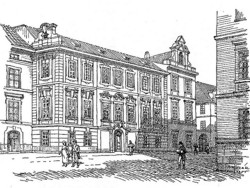
Estates Engineering School in Prague
The Estates School of Engineering in Prague originated forty years earlier than the prestigious and still existing Bridge and Highway School
(École des Ponts et Chaussées) in Paris, which was founded in 1747. While in its beginnings under the leadership of its founder and the first
professor Ch. J. Willenberg, a renowned expert in fortifications, the Estates Engineering School in Prague was intended to
specialize in military and fortification engineering, its focus soon turned towards civil engineering. This transformation started under
the management of the second professor, J. F. Schor, an outstanding artist, painter and architectural theorist, and continued
after his death, under the management of the third and last professor, F. A. Herget, a distinguished specialist in surveying
and water management.
In 1787, during Prof. Herget´s tenure, the Estates Engineering School in Prague temporarily merged with Charles-Ferdinand University
in Prague, although the School still maintained its own chief administrator. In 1815, the School regained independence under the name of
the Royal Bohemian Estates Polytechnic School, under Professor F. J. Gerstner, a prominent astronomer, surveyor and specialist
in hydraulic and railway structures. Based on his proposal, the School was restructured in 1798, or 1803, respectively, following the French
model of École polytechnique in Paris, founded in 1794. The teaching started as early as 1806.
Czech introduced as the language of instruction
The second half of the 19
th century marked a new, important epoch in the School development. In 1861, thanks to Professor Skuherský´s
undaunted attitude, Czech was introduced as the language of both instruction and administration side by side with German, hitherto used exclusively.
In 1864, the School was divided into the Czech and the German part. These changes were also significantly affected by the rapidly developing industries.
As early as 1863, when organic statutes granting equal rights to the Czech and German language were issued, four individual fields of study were
introduced: hydraulic and highway engineering, civil engineering, mechanical engineering and technical chemistry. In 1864 to 1869, instruction was held
at the so-called Utraquist Polytechnic representing the Czech and German dualism. Finally, in 1869, the Royal Bohemian Polytechnic National Institute
was divided into two independent institutes: Czech and German.
Czech Technical University since 1920
After the nationalization of both Polytechnic National Institutes in 1875, the Czech Institute was renamed
the Royal and Imperial Bohemian
Technical University in Prague in 1879.
In 1920, in accordance with the new organizational statutes,
the name of
this supreme school of technology was changed to the Czech Technical School in Prague.
During the occupation of the country by Nazi Germany, all universities were forcibly closed from 1939 to 1945. After the liberation, the Czech Technical
University in Prague resumed its activities. Following the changes of 1920, the University comprised seven individual colleges (independent faculties):
Civil Engineering, Architecture and Building Construction, Mechanical and Electrical Engineering, Chemical Technology and Engineering, Agricultural and
Forestry Engineering, Special Sciences and Commerce.
In 1951, the Faculty of Mechanical and Electrical Engineering was divided into the Faculty of Mechanical Engineering and the Faculty of Electrical Engineering.
In 1952, the Faculty of Agriculture and the Faculty of Chemical Technology left the Czech Technical University and were set up as separate universities.
At that time, the Act of the Ministry of Education of 1950 was fundamental for the reorganization of the Czech Technical University. By this law, the College
of Commerce or the College of Economic Sciences was ultimately closed down and dissolved. In 1959, the Faculty of Nuclear Sciences and Physical Engineering was
established and in 1994 the Faculty of Transportation Sciences, followed by the Faculty of Biomedical Engineering in 2005. The Faculty of Information Technology
became the eighth CTU faculty on July 1, 2009.
Faculty of Civil Engineering CTU in Prague
In terms of the mission, organisation and the complex concept of the present-day Faculty of Civil Engineering, it is highly significant and symbolic that it was
three leading personalities of their time, who deserve credit for founding and gradually developing the Estates Engineering School and promoting a many-sided
approach to civil engineering issues. They were distinguished specialists in the field of civil and fortification engineering (first professor Ch. J. Willenberg),
art and architecture (second professor J. F. Schor) and mathematics, surveying and civil engineering (third professor F. A. Herget).
The statutory development proceeded hand in hand with the organisational development of technical universities. In spite of the original absence of rules for both
registration for lectures and holding examinations, the final qualification was declared in a public and ceremonial way from the very beginning. It was only
in 1878 that two final graduation examinations were introduced at the Royal and Imperial Bohemian Technical University in Prague, and, in 1901, when the state
examination code was issued, the Prague Polytechnic was granted the right of conferring the Doctor of Technical Sciences degree (the first doctoral graduation ceremony
was held in 1902).
The Faculty of Civil Engineering came into existence in 1960 by merging the independent Faculties of Architecture and Building Construction, Civil
Engineering, the Faculty of Surveying and the civil engineering branch of the dissolved Faculty of Economic Engineering. In 1976, the Faculty of Architecture once
again established its independence.