
The study in this program is subjected to tuition fees charged.
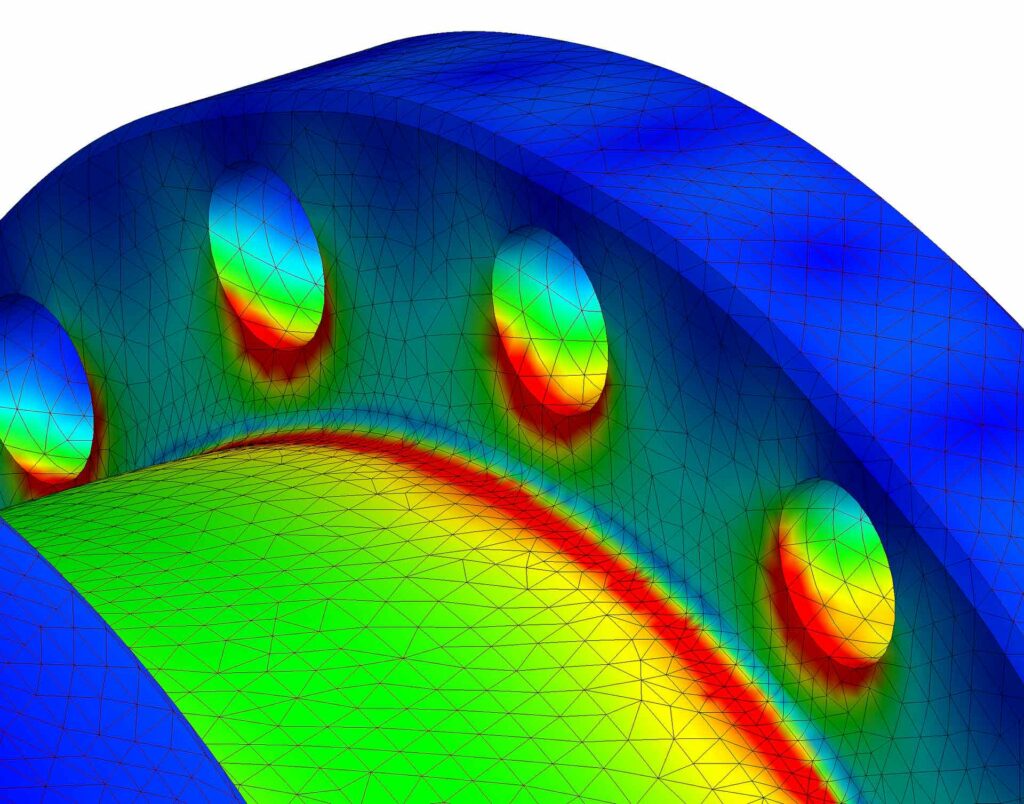
The doctoral degree programme focuses on the acquisition of theoretical knowledge and practical skills enabling the successful mathematical and computational modelling of challenging problems motivated mainly by research related to civil engineering.
The doctoral degree programme builds on the assumption that no advanced research can be attempted without the application of mathematical methods and the results obtained through this research cannot be correctly communicated without their proper understanding. Moreover, research itself leads to the study of increasingly more demanding models; allow us to mention just a few from civil engineering: coupled problems (e.g. nonlinear heat and moisture transport), problems with hysteresis operators (e.g. to describe flow in porous media), the Bayesian approach to problems with random data, fast solutions of homogenization problems, etc.
In the upcoming period, characterized, among other things, by dynamic changes, employees and entrepreneurs alike will be required to attain a considerable degree of flexibility and readiness to change their work focus or even their field of work. As the MCE doctoral degree study programme also takes this tendency into account – the graduates will accordingly acquire skills in mathematics and computer modelling that are generally applicable, because many mathematical models used in different specializations speak the same mathematical language.
The graduates of the MCE programme will find employment as, e.g.:
GUARANTOR AND BRANCH BOARD CHAIR OF THE DOCTORAL DEGREE STUDY PROGRAMME OF
MATHEMATICS IN CIVIL ENGINEERING
Responsible: prof. Ing. Petr Konvalinka, CSc., FEng.
We use cookies and similar technologies to improve your experience, analyse traffic and display relevant content. Without your consent we will not store non-essential cookies. Rejecting may affect some website features.
ŠTUK (STUdent Klub) was established on the students’ initiative in 2012, and its operation and activities have always been managed by the students. It focuses on the student life at school – it organizes, for example, the Formwork Welcome Party, but also field trips, workshops, discussions, lectures, film screenings and other events for future engineers and architects who do not want to spend their time at school by learning only. There is also a clubroom (As140) available, where you can relax, sit down with a book or chat with friends.